ADA Website Lawsuits in 2026: What Businesses Need to Know
Website accessibility lawsuits keep rising. What a settlement costs, how much a lawsuit is worth to the plaintiff, what a defense lawyer will ask you for, and a checklist to lower your risk.
How many website accessibility lawsuits are being filed
Website accessibility lawsuits are not a passing trend. Seyfarth Shaw, which tracks federal ADA Title III filings, counted 3,117 federal website accessibility lawsuits in 2025. That was a 27% increase over the 2,452 filed in 2024. Website cases made up 36% of all ADA Title III lawsuits filed in federal court in 2025.
Federal court is only part of the picture. UsableNet, which also tracks New York and California state courts, counted 4,928 web accessibility lawsuits for the full year 2025, and its monthly tracker logged 360 more in September 2026 alone. Of those September defendants, 91 were sued while running an accessibility widget. Counts differ between trackers because they cover different courts and different definitions, so treat any single number as a snapshot rather than a final tally.
2026 is on course to beat 2025. Seyfarth's mid-year report, published September 9, 2026, counted 5,006 federal ADA Title III suits of all kinds in the first half of 2026, up 9% on the same period of 2025, with California (2,426), Florida (709) and Illinois (505) leading. If the pace holds, the firm expects 2026 to end with over 10,000 federal filings. For website suits specifically, New York led 2025 with 1,021, then Florida with 961 and Illinois with 585.
Who gets sued
E-commerce is the largest target. UsableNet reported that eCommerce represented 69% of the lawsuits in its midyear 2025 data. The pattern follows the barrier: a plaintiff who cannot buy, book, or apply on a site has a concrete claim, so sites that take orders or payments draw the most attention.
Small businesses are not exempt. Demand letters go to companies of every size, including owners of local businesses whose website was built from a template and never tested with a screen reader. UsableNet's data cuts the other way too: in the first half of 2025, 36% of the companies sued had revenue above $25 million, so the plaintiffs' bar is not only chasing small shops.
How much an ADA website lawsuit costs to settle
Most ADA website claims against small businesses settle for between $5,000 and $20,000, and some settle for less than $5,000. That range comes from Accessible.org, whose founder reviews these claims for defendants; it reports that small businesses can usually settle for $10,000 or less even when the plaintiff's firm is in New York, and that the price rises once a complaint is filed or motions are exchanged. These are private settlements, so there is no official register, and vendor blogs that quote averages of $25,000 or more are estimating.
The settlement cheque is only part of the bill. Federal ADA claims do not carry money damages for the plaintiff. What the plaintiff's lawyer is paid for is attorney's fees, which the statute lets a prevailing party recover, so the demand is really a fee demand. On top of it you pay your own lawyer, the cost of fixing the site, and often an agreement to audit and retest within a set period. Add those and the fix work usually costs more than the payment.
Where a state law applies, the exposure changes. California's Unruh Act adds statutory damages of at least $4,000 per offense, which is why California claims are priced higher and why the Domino's plaintiff was awarded exactly that figure in 2021. New York plaintiffs rely on state and city human rights laws, which also allow damages, so New York cases cost more than Florida ones with the same facts.
- Typical small-business settlement: $5,000 to $20,000, sometimes under $5,000 (Accessible.org).
- Federal ADA: injunction plus attorney's fees, no damages to the plaintiff.
- California Unruh Act: at least $4,000 per offense on top of the ADA claim.
- Remediation, your own counsel and any agreed retesting are extra, and usually larger.
How much an ADA website lawsuit is worth to the plaintiff
To a plaintiff's firm, a website case is worth a quick fee settlement multiplied by volume. Seyfarth found that one plaintiff and one firm were behind every one of the 121 website accessibility suits filed in Missouri in 2024 and 2025. A firm that files hundreds of near-identical complaints and settles each for a few thousand dollars in fees has a business, which is why the same handful of firms and plaintiffs show up across states.
States have started to push back. Missouri passed a law in May 2026, operative from August 28, 2026, that lets a business sued over its website ask a court to declare the suit abusive litigation and recover its defense costs, with sanctions of up to three times the fees awarded. The law creates a presumption of abuse when the business received written notice and started substantial fixes in good faith within ninety days. New York federal courts have also tightened standing rules, which is one reason New York dropped to fourth for federal ADA Title III filings in the first half of 2026 after leading website filings in 2025.
What a demand letter looks like and what to do when one arrives
A demand letter is usually a short, formal letter or email from a lawyer for a person who says they could not use your website because of a disability, such as blindness or low vision. It typically lists the barriers they found, such as images without text alternatives, forms with no labels, or checkout steps that cannot be completed with a keyboard. It then asks for a payment and sometimes an agreement to fix the site within a set period.
Do not ignore it. A letter that is not answered can lead to a lawsuit, and recent filings show plaintiffs using state courts as well as federal ones. Talk to a lawyer who handles ADA website matters before you respond, and note any deadline the letter sets. Keep a copy of the current version of your site and any earlier audit reports, because deleting them can look like destroying evidence. Avoid replying directly with admissions or with promises you cannot keep, and do not dismiss the claim without understanding what it alleges.
While your lawyer works on the response, you can start a documented review of the barriers listed. Fixing the problems is valuable in its own right, and a record of prompt, good-faith work can matter in later negotiations. Under Missouri's new law it is the fact that creates a presumption the suit is abusive.
What a defense lawyer will ask you for
A defense lawyer handling a website claim asks for evidence first and arguments second. The first question is whether the barriers in the letter exist, so they want a current scan of the pages named, against WCAG 2.1 AA, with the date it was run. The second is history: every earlier audit, the fixes shipped and when, and any accessibility statement you published, because a record of ongoing work is what turns a demand into a small settlement or a dismissal. In April 2026 a federal court dismissed a website suit as moot on unrebutted evidence that the site was accessible, which is the outcome that evidence buys.
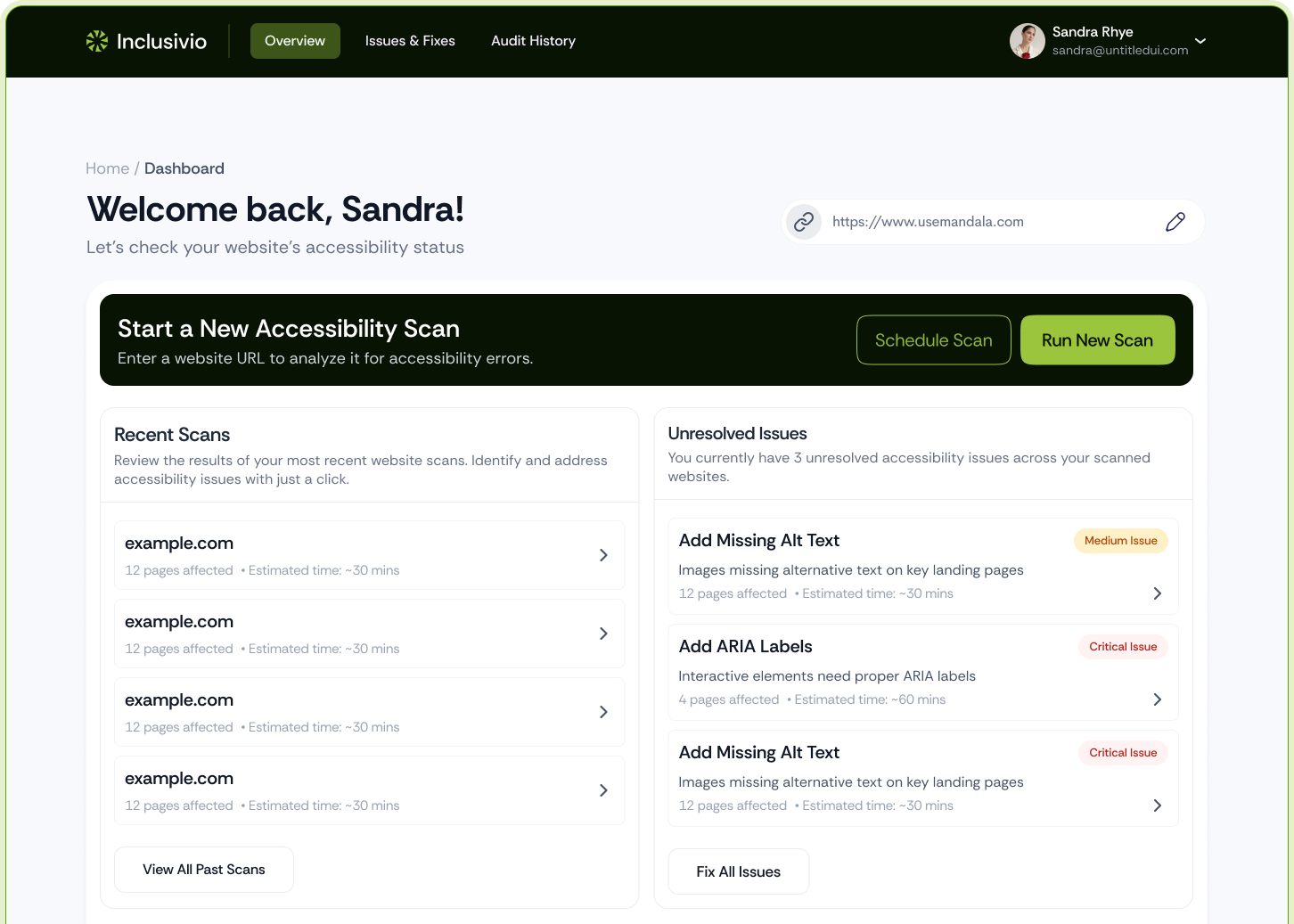
This is the report Inclusivio generates. A scan produces a dated list of issues by WCAG criterion with the element and a screenshot of each, the AI scan adds the issues a rule check cannot see, and the scan history shows what was found and fixed on which date. Hand that to your lawyer on day one and they are not starting from a blank page.
- A dated scan of the pages the letter names, listed by WCAG 2.1 AA criterion.
- Audit and fix history: what was found, what shipped, and when.
- Your accessibility statement and the contact route it gives visitors.
- The theme, plugins and third-party scripts on the site, since many barriers come from them.
- Any earlier letters or suits, and how they were resolved.
The legal standard: Title III, courts, and WCAG
Title III of the Americans with Disabilities Act says that no individual shall be discriminated against on the basis of disability in the full and equal enjoyment of the goods, services, facilities, privileges, advantages, or accommodations of any place of public accommodation. The statute was written with physical places in mind. Whether a website is a place of public accommodation, or a service of one, is the question courts have been working through for years.
The Web Content Accessibility Guidelines (WCAG) published by the W3C are the technical benchmark most people use to test a site. The statute does not name WCAG, and a court does not automatically treat a site that misses a WCAG success criterion as a violation. In practice, WCAG 2.1 AA is the level that the DOJ adopted for government sites and the one most auditors test against, which makes it a sensible target for a business.
The law is not settled across the country. Courts disagree about how far Title III reaches online services, and the Second Circuit has not decided whether online-only businesses are covered. Businesses should not rely on a favorable ruling in one state to decide their exposure in another.
Named cases: Target, Domino's and Winn-Dixie
The case that put a price on website accessibility was National Federation of the Blind v. Target. In August 2008 Target agreed to pay $6 million into a fund for blind customers in California who had been unable to use target.com, to make the site accessible by February 28, 2009, and to let the NFB test the site for three years. Target admitted no wrongdoing. Eighteen years later it is still the largest publicly known website accessibility payment, and the reason the number appears in every demand letter negotiation.
The key appellate decision for plaintiffs is Robles v. Domino's Pizza, decided by the Ninth Circuit on January 15, 2019 (docket No. 17-55504). A legally blind customer who uses a screen reader said he could not order a customized pizza through Domino's website or app. The Ninth Circuit held that the ADA applies to Domino's website and app, because they are connected to its physical restaurants and provide services of a place of public accommodation. The Supreme Court declined to hear the case in October 2019. Back in the district court in 2021, Domino's lost on summary judgment and the plaintiff was awarded $4,000 under California's Unruh Act. The parties settled on June 6, 2022 on undisclosed terms. Three years of appeals over a $4,000 award tells you the money was always in the fees, not the damages.
The most important case for defendants is Gil v. Winn-Dixie Stores. In April 2021, the Eleventh Circuit held that websites are not places of public accommodation under Title III, which would have bound federal courts in Florida, Georgia, and Alabama. On December 28, 2021, the court vacated that decision on rehearing as moot, because the injunction requiring Winn-Dixie to improve its website had expired in 2020. The vacated opinion no longer binds the circuit, so the question is open there. Anyone following this area should read the full history of a case, not just its headline holding.
The DOJ rule for state and local governments
In April 2024 the Department of Justice issued a final rule under Title II of the ADA requiring state and local governments to make their web content and mobile apps accessible. The rule adopts WCAG 2.1 Level AA as the technical standard. It applies to government entities, not to private businesses directly, but it is the clearest federal statement of what an accessible public-facing site looks like, and plaintiffs and courts often look to it.
The compliance dates have moved. An interim final rule published on April 20, 2026 extended the original deadlines. Public entities serving 50,000 or more people now have until April 26, 2027, and smaller public entities and special district governments have until April 26, 2028. The technical standard did not change. If your business works with a city, county, school district, or state agency, expect those buyers to ask for WCAG 2.1 AA evidence.
State laws that raise the stakes
Federal ADA claims in private lawsuits generally seek an injunction, which orders the business to fix the site, along with attorney's fees. State laws can add money damages. California's Unruh Civil Rights Act, Civil Code section 52, sets damages of no less than $4,000 for each offense. Because a plaintiff can bring an Unruh claim alongside an ADA claim, California cases often carry more financial exposure than an ADA claim alone.
Other states have their own disability access laws, and the rules differ in what they require and how damages are calculated. If you operate in more than one state, you need advice that covers each state where your customers are, not just where your company is registered.
Outside the United States
The European Accessibility Act, Directive (EU) 2019/882, applies to consumer-facing products and services offered in the EU. From June 28, 2025, new products and services in scope must be accessible, and the directive covers e-commerce services, consumer banking services, and websites and mobile apps. The full requirements apply to in-scope services from June 28, 2030. Microenterprises with fewer than 10 employees and turnover or a balance sheet not above EUR 2 million may be exempt, and a separate exemption may apply where compliance would be a disproportionate burden.
In Canada, Ontario's Accessibility for Ontarians with Disabilities Act (AODA) requires public websites and web content to meet WCAG 2.0 Level AA. The requirement applies to designated public sector organizations and to businesses and non-profits with 50 or more employees. If you sell into Ontario or the EU, these rules apply to you whether or not you are based there.
Why an overlay alone does not reduce the risk
Accessibility overlays are scripts that promise to fix a site from the outside, usually by adding a toolbar or an automated layer over the page. They can help some users, but they do not repair the underlying code, and they cannot make every page usable with a keyboard or a screen reader.
The Federal Trade Commission took action on this point. In January 2025 it announced a settlement with accessiBe over claims that its AI-powered accessibility tool could make any website WCAG-compliant. The FTC alleged those claims were false, misleading, or unsubstantiated, and that the company presented paid reviews as independent. In April 2025 the Commission approved a final order requiring accessiBe to pay $1 million. The order bars the company from claiming its products can make any website WCAG-compliant, or can ensure continued compliance, without evidence to back the claim. The lesson is simple. A vendor's promise does not show that a site works for people who use screen readers or keyboards, and a business that relies on an overlay alone has not fixed the barriers a plaintiff can test.
A practical checklist to reduce your risk
Reducing risk is a process, and it works best when it is written down. The steps below are the ones most businesses can start this quarter. They reduce the chance of a barrier going unnoticed, and they give you a record if a demand letter arrives. They do not guarantee that no claim will be filed.
- Audit the site against WCAG 2.1 AA, including automated testing and manual checks with a keyboard and a screen reader on the pages customers use most, such as checkout, booking, contact, and account pages.
- Fix the issues in the source code, starting with the ones that block a task: missing form labels, images without text alternatives, unreachable buttons, and focus that disappears.
- Keep a dated record of each audit, each fix, and each retest, so you can show ongoing work rather than a one-time check.
- Publish an accessibility statement with your contact details and the standard you target, and make it easy for customers to report a barrier and get a response.
- Set up regular monitoring after each release, because a new feature or a plugin update can add barriers to a site that passed last month.
- Review third-party tools, themes, and embedded widgets, since a vendor component can create a barrier on your pages.
- Prepare a VPAT or accessibility conformance report for buyers, especially government and enterprise customers, and keep it current with your product.
- Write a plan for responding to a demand letter now, including who to call and where your audit records live, so you are not deciding under pressure.
Inclusivio helps teams do the work this checklist describes. The platform scans sites against WCAG, uses an AI agent to look for issues that rule-based checks miss, proposes an AI fix for each issue, and keeps scan history and reports so you can document ongoing work. For teams that need more, we offer VPATs and expert audits, and litigation support is included on the Scale plan. You can compare plans at /pricing or write to contact@thea11ylabs.com.
This article is general information, not legal advice. ADA and state accessibility law depends on the facts of each case and your location, so speak with a qualified attorney before responding to a demand letter or changing your legal approach.
Sources
- Seyfarth Shaw: Federal Court Website Accessibility Lawsuit Filings Bounce Back in 2025
- Seyfarth Shaw: 2026 Mid-Year Report, ADA Title III Federal Lawsuit Numbers Are Climbing
- UsableNet: Web Accessibility Lawsuits Tracker (2025 total and September 2026 numbers)
- Seyfarth Shaw: Missouri Passes Law to Deter 'Abusive' Website Litigation
- Seyfarth Shaw: Lawsuit Dismissed as Moot Based on (Unrebutted) Evidence that Website Is Accessible
- Accessible.org: ADA Website Compliance Lawsuit Settlement Amounts
- National Federation of the Blind: NFB and Target Agree to Class Action Settlement (2008)
- Bureau of Internet Accessibility: The Robles v. Domino's Settlement (and Why It Matters)
- U.S. Department of Justice: Accessibility of State and Local Government Websites and Mobile Apps (ADA.gov)
- Illinois Lawyer Now: DOJ Extends Title II ADA Web Content Accessibility Compliance Deadlines
- 42 U.S.C. 12182, ADA Title III Prohibition Against Discrimination (Cornell Law School)
- BCLP: Ninth Circuit Issues Important Decision in Domino's Website Accessibility Action
- Epstein Becker Green: The Eleventh Circuit Finally Breaks Its Silence on Website Accessibility
- Perkins Coie: Eleventh Circuit Vacates Ruling That Websites Are Not Public Accommodations Under the ADA
- California Civil Code section 52 (Unruh Civil Rights Act)
- Reed Smith: The EU Accessibility Act Is Now in Force
- Government of Ontario: How to Make Websites Accessible (AODA)
- FTC: FTC Approves Final Order Requiring accessiBe to Pay $1 Million
- W3C: Web Content Accessibility Guidelines (WCAG) 2.1