Accessible Websites Are 57x Cheaper for AI Agents to Read
We counted what an AI agent reads on eight popular websites. Through the accessibility tree, it's a median of 57 times less than the raw code.
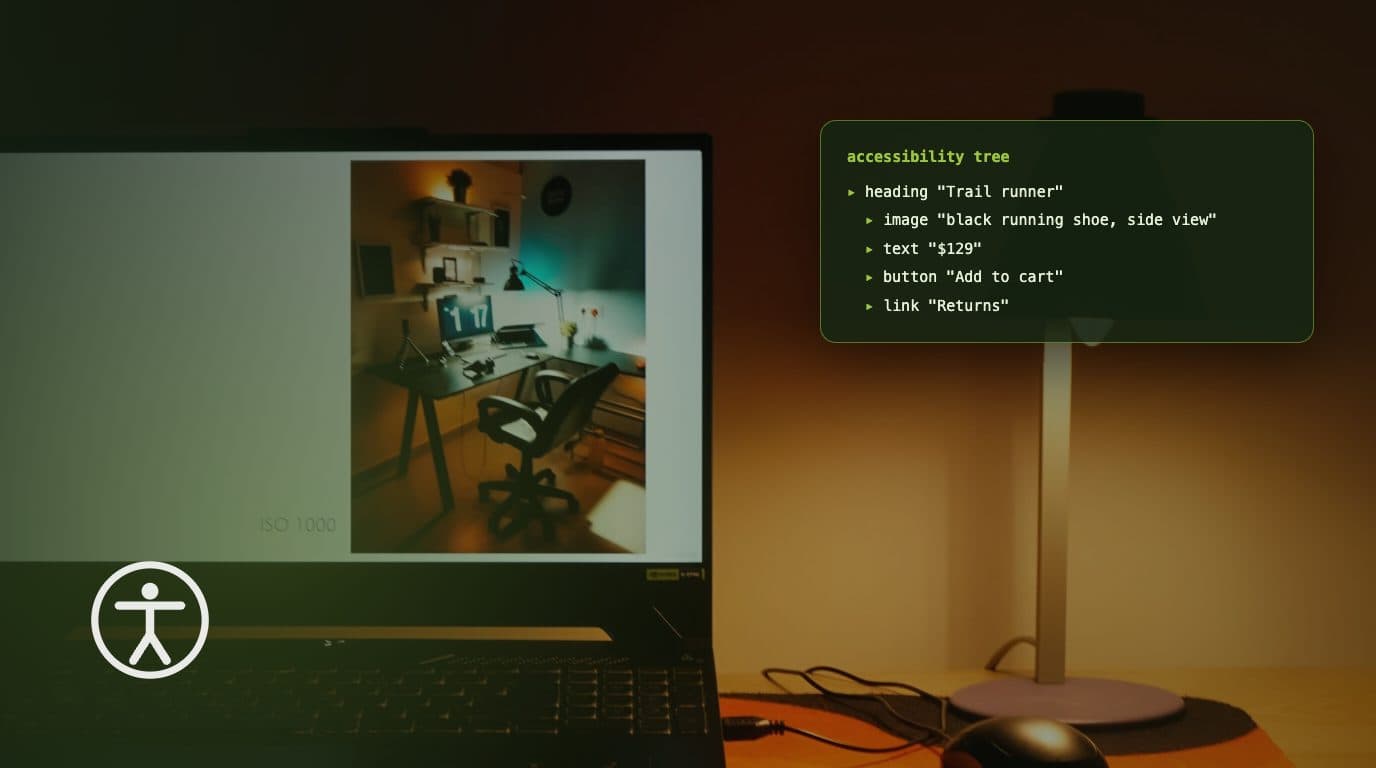
The page behind the page
Every website has two faces. One is the design you paid for, all type and colour and photography. The other is plainer and far older: a running list of what's on the page and what each part does. This is a heading. That is a link to returns. Here is a button, and it's called Add to cart.
Browsers keep that second face for screen readers, and blind customers have navigated by it for decades. It's called the accessibility tree. AI agents have quietly adopted it as well.
How does an agent actually read your site?
In one of three ways, and they're not equally expensive.
- Raw HTML: the whole kitchen, receipts and all. Scripts, styling and tracking code arrive alongside the content.
- Screenshots: reading a book by photographing every page, then guessing which words are buttons.
- The accessibility tree: the menu. One line per heading, link, field or image, and nothing else.
57x
That's the median difference between the raw HTML and the tree on eight popular websites, counted with OpenAI's own tokenizer at a 1440 by 900 desktop size. Screenshots, priced by OpenAI's published image rules, came out 3.9 times heavier than the tree. The spread is wide; a text-heavy article barely shrinks, while a store full of scripts collapses to almost nothing.
- W3C Accessibility Initiative: 12,733 tokens of HTML, 111 in the tree (115x)
- Allbirds: 234,618 and 2,283 (103x)
- GitHub: 205,706 and 2,524 (82x)
- Stripe: 326,663 and 4,097 (80x)
- Design Tennis: 47,949 and 1,429 (34x)
- BBC News: 117,906 and 3,777 (31x)
- GOV.UK benefits: 22,896 and 1,157 (20x)
- Wikipedia, on web accessibility: 214,765 and 20,079 (11x)
$296,000 or $8,900
Our average page weighed in at roughly 148,000 tokens of HTML and 4,400 in the tree. Price a million page reads at $2 per million input tokens and the first route costs about $296,000; the second, $8,900. Same pages. Same facts. One bill is thirty-three times the other.
Pictures cost extra
Those figures are generous to HTML, because they leave the images out. An image tag is only an address. To learn what the photo shows, an agent must fetch it and pass it to the model (anywhere from 85 to over 1,000 tokens apiece), whereas in the tree a well-written description has already answered the question.
Broken structure is a locked door
A button built from a styled box doesn't appear in the tree at all. An unlabelled field is a blank. A photo without a description is an empty frame, and the agent must either walk past it or pay to look.
Screen reader users meet the same locked doors, and there are a lot of them. WebAIM's 2026 survey of the top million home pages found detectable failures on 95.9%, with half missing form labels. Which means the readable sites, few as they are, get noticed.
WebMCP skips the reading altogether
Why make a visitor read the menu when you could take the order? WebMCP lets a site register named actions, such as searching products or opening a section, and agents call them directly. It's a draft from the W3C Web Machine Learning Community Group, edited by people from Google and Microsoft, and Chrome has offered it to developers through an origin trial since version 149.
Our widget already speaks it. A visiting agent can list a page's sections, move to any of them, or enlarge the text for the person it's helping, without parsing a single line.
Your tests are agents too
Playwright tells developers to find elements by role and name, because those survive a redesign, and its MCP server reads pages through accessibility snapshots unless told otherwise. Accessible front ends give a CI pipeline sturdier tests, and give AI test agents a slimmer page to pay for on every run.
Getting your site ready
Begin with the structure your visitors already depend on. The heading that orients a screen reader user is the same signpost an agent follows.
Inclusivio finds the gaps across every page and fixes them where they start: unnamed buttons, undescribed images, unlabelled fields, headings out of order. It checks each release before customers see it, so the repairs hold. Add the widget, and arriving agents find WebMCP tools waiting.
So the number to remember is 57. That is how much less an agent reads on an accessible page than on the raw code behind it, and the same ratio sets the cost of every visit it makes on someone's behalf.
Your site already has a number. Scan a page below and we will tell you what it is, and what is standing between it and a lower one.
