European Accessibility Act 2026: How to Avoid Penalties and Make Your Website Compliant
Enforcement under the European Accessibility Act has started. Make your website and online shop meet WCAG 2.1 AA before complaints and penalties reach you.

Why the European Accessibility Act matters for your business
If you sell to people in the European Union, your website, app and online shop now have to work for people with disabilities. The European Accessibility Act (EAA), Directive (EU) 2019/882, applies to services provided to consumers from 28 June 2025, and it covers the digital channels most businesses run every day: websites, apps, e-commerce, e-books and consumer banking.
The risk is already visible. In Germany, the Barrierefreiheitsstärkungsgesetz (BFSG) allows fines of up to €100,000 for serious violations. In France, disability organisations sent formal legal notices to major retailers in 2025, and in June 2026 a court ordered one of them to make its online shop and app fully accessible within six months. Dutch and Swedish regulators have started writing to e-commerce operators. Complaints are easy to file, and the people who file them are the customers you want to keep.
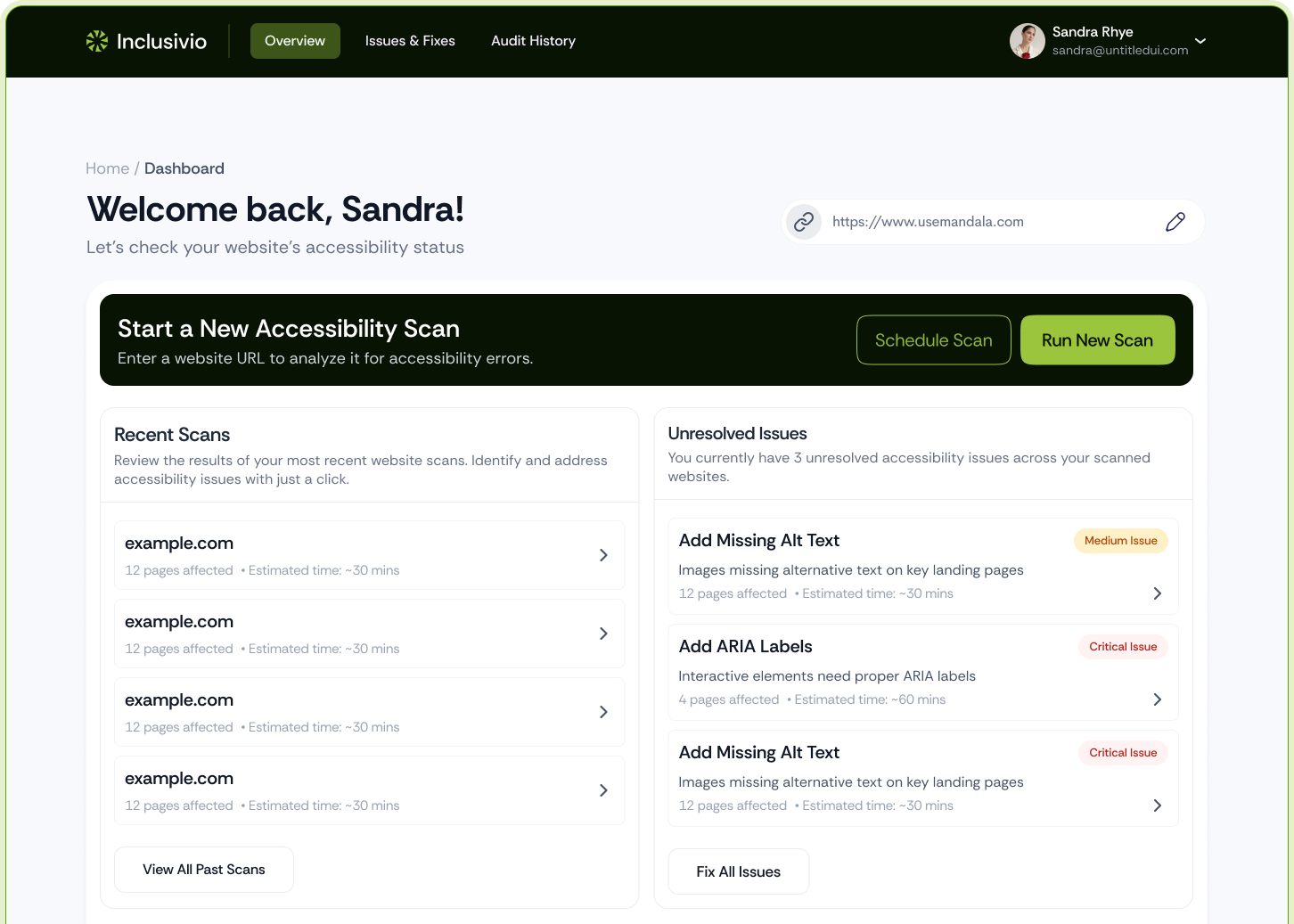
The path to compliance is clear. The EU points to one standard, EN 301 549, which uses WCAG 2.1 Level AA for web content. Inclusivio covers the full loop on one platform: it scans your site against WCAG 2.1 AA, AI agent scans catch the issues rule checkers miss, AI fixes each issue, and scan history and dated reports document the ongoing work. Visitors with disabilities can use our accessibility widget directly, with text size, contrast, reading guides, a reading mask, readable fonts and stopped animations. Elixir, our voice assistant, works alongside VoiceOver, NVDA and JAWS. PDF accessibility, expert audits, VPATs and accessibility conformance reports, and litigation support are available when you need them. Plans are priced in euros on our pricing page.
Who does the European Accessibility Act apply to?
The European Accessibility Act applies to businesses that offer covered products and services to consumers in the European Union. For digital businesses, the covered services include e-commerce services, electronic communications services, audiovisual media services, consumer banking services, and e-books and dedicated software (Article 2(2)).
If customers buy from you through a website or app, the Act applies to that channel. Germany's BFSG lets service providers keep using products they lawfully used before 28 June 2025 until 27 June 2030, and lets service contracts signed before that date run to their agreed end, but no later than 27 June 2030.
- E-commerce services, including online shops and checkouts.
- Electronic communications services and consumer banking services.
- Audiovisual media services and e-books.
- Dedicated software, such as the apps customers use with your services.
What are the penalties for not complying with the European Accessibility Act?
Each EU member state sets its own penalty amounts, but the directive requires penalties that are effective, proportionate and dissuasive (Article 30(2)).
Germany shows the scale. Under section 37 of the BFSG, serious violations, including offering or providing a service that does not meet the requirements, can be fined up to €100,000. Other breaches, such as missing or incorrect information, can be fined up to €10,000. Germany's market surveillance for the BFSG is run by the MLBF, a joint authority of the 16 federal states based in Magdeburg.
Enforcement is already under way through complaints, legal notices and court orders, though as of mid-2026 no monetary fine had been confirmed under any national EAA law. The cases so far are court orders and regulator reviews, which cost more than a fine would.
- Serious violations: up to €100,000 under BFSG section 37 in Germany.
- Formal legal notices and court orders requiring a site or app to be made accessible.
- Daily financial penalties for missing a court deadline.
- Private warning letters from law firms to e-commerce operators in Germany.
Enforcement cases so far: France, Sweden, the Netherlands and Germany
France produced the first court order. On July 7, 2025 four disability organisations sent formal legal notices to Auchan, Carrefour, E. Leclerc and Picard. When the replies were judged insufficient they filed emergency injunctions on November 12, 2025. The Lille court dismissed the Auchan case on May 5, 2026 on procedural grounds, while noting that the site did not meet the standard; the organisations are appealing to Douai. On June 4, 2026 the Caen judicial court ordered Carrefour France to make carrefour.fr and its app fully accessible within six months, with a financial penalty for each day of delay after that. Carrefour's own defence was that it already met 71% of the French RGAA criteria, which the court did not accept as enough.
Sweden's regulator, PTS, opened its first e-commerce cases in October 2025 after receiving 124 public complaints, 110 of them about services and mostly online shops. Each review covers the homepage, one product page and the search function. The Dutch ACM ran voluntary self-reporting until October 15, 2025, then sent information requests to e-commerce operators worldwide, including companies outside the EU, and has said formal enforcement is expected in the second half of 2026. In Germany, enforcement started privately: law firms sent warning letters to shop operators under unfair competition law within weeks of the BFSG taking effect. Finland, Luxembourg and Italy have set up channels for reporting non-compliance.
- France: first court order, Carrefour, June 4, 2026, six months to comply with daily penalties.
- Sweden: 124 complaints, first regulator cases from October 2025.
- Netherlands: information requests to shops worldwide, formal enforcement expected in late 2026.
- Germany: private warning letters under competition law from July 2025.
Ireland: the European Accessibility Act as a criminal offence
Ireland is the member state to watch if you sell in English, because it made non-compliance a criminal offence. The European Union (Accessibility Requirements of Products and Services) Regulations 2023, S.I. No. 636 of 2023, took effect on June 28, 2025. The Competition and Consumer Protection Commission (CCPC) is the market surveillance authority for products and the compliance authority for e-commerce, e-books and dedicated software; ComReg covers electronic communications, Coimisiún na Meán covers audiovisual media and the Central Bank covers consumer banking.
The penalties are set in the regulations. On summary conviction, a fine of up to €5,000 or up to six months in prison; on indictment, a fine of up to €60,000 or up to 18 months. The offence is failing to comply with a direction from the authority, so the process starts with a notice and a chance to fix the service, which is why the CCPC said at launch that it would lead with support and guidance, especially for microenterprises. Any consumer can report a non-accessible product or service to the CCPC through its website.
- Regulation: S.I. No. 636 of 2023, in force June 28, 2025.
- Authority for online shops, e-books and software: the CCPC.
- Summary conviction: up to €5,000 or six months; indictment: up to €60,000 or 18 months.
Which standard should an EU website meet?
An EU website should meet EN 301 549, the European accessibility standard for ICT products and services, which uses WCAG 2.1 Level AA for web content. Canada adopted the 2021 edition as CAN/ASC-EN 301 549:2024, an identical adoption, which shows how closely the standard follows the European text.
WCAG 2.1 is the W3C Recommendation that defines the testable success criteria at Levels A, AA and AAA. Level AA is the level the EU standard refers to for web content, so it is the level to build and test against. Inclusivio scans your site against WCAG 2.1 AA and reports each issue against the criteria it breaks, so your team knows what to fix and why.
Standards are only as good as the testing behind them. Test every key page with the keyboard alone, then with VoiceOver on Mac and iPhone, NVDA on Windows and JAWS, because screen readers expose problems that automated checks cannot see, such as a confusing reading order, a button that announces no name, or a form error that is never spoken aloud. Inclusivio's AI agent scans reach a further set of issues that rule-based checks miss, and Elixir works alongside the same screen readers, so your team can test the experience the way a customer would.
How do businesses avoid European Accessibility Act enforcement?
Businesses avoid enforcement by fixing the barriers that complaints and regulators target, and by keeping dated evidence that the work is ongoing. Regulators do not only look at the homepage. Swedish regulators reviewed homepages, product pages and search functions when they opened their first e-commerce cases in October 2025.
- Audit the site and app against WCAG 2.1 AA, including the pages customers use to buy.
- Run the AI agent scan to find issues that automated rule checks miss.
- Fix each issue with the AI fix suggested for it, then verify the result.
- Document the work as you go. A dated scan history and a record of the date each fix shipped is what you need when a complaint, a customer's accessibility questionnaire or a regulator's question arrives. Inclusivio records each scan and its results as they happen, so the evidence exists before anyone asks for it.
- Name one owner for accessibility, so every release is checked before it goes live.
- Keep scan history and dated reports, so every change is on record.
- Publish a VPAT or accessibility conformance report, so buyers and regulators can see where you stand.
- Give visitors the accessibility widget, so people with disabilities can adjust your pages themselves.
Are small businesses exempt from the European Accessibility Act?
Only microenterprises providing services are exempt. A microenterprise employs fewer than 10 persons and has an annual turnover or an annual balance sheet total of no more than €2 million (Article 3(23)). Microenterprises providing services are exempt from the accessibility requirements and the obligations that come with them (Article 4(5)).
A business with ten or more employees is outside the exemption, and so is a business whose turnover and balance sheet total are both above €2 million. Count your headcount and both financial figures before you decide, not just the size of your shop.
If you are close to the line, build to the standard anyway. The fixes EN 301 549 asks for also make search, filters and checkout easier for every shopper, so the work pays back in conversion even where an exemption applies.
What about businesses outside the EU that sell to EU customers?
Businesses outside the EU are covered when they offer covered products or services to consumers in the European Union. The directive sets its scope by the service and the consumer, and the text does not limit it by where the provider is established (Article 2(2)).
Regulators are already acting on that reading. The Dutch ACM sent information requests to e-commerce operators worldwide, including companies outside the EU, and Level Access reports that formal enforcement is expected in the second half of 2026. A US or UK store that ships to Germany, France or the Netherlands is in scope for those orders. Build one accessible site for every market, rather than maintaining separate versions for the EU and everywhere else.
The exposure also follows the customer rather than the company. A sale to a shopper in Berlin, Paris or Amsterdam is a sale into the Act's scope, whether the order is shipped from a warehouse in Ohio, Manchester or Lagos. Checkout, shipping options, returns and the account area are all part of the service a European consumer uses, so they are all part of the audit.
Who enforces the European Accessibility Act and how are complaints made?
Each member state's national authorities enforce the Act, and in Germany the MLBF enforces the BFSG. Consumers can report barriers to the MLBF through an online form for barriers in products and services, or submit a formal application under section 32(1) of the BFSG to claim a barrier.
Complaints also come from disability organisations, competitors and law firms, which is why warning letters and court claims are common. Inclusivio helps you respond fast: your scan history shows when each issue was found and when it was fixed, so you can answer a complaint with evidence.
A complaint does not need a lawyer to start. Any customer who cannot finish a purchase can report the barrier, usually with a page address and a description of what stopped them. Make your accessibility contact easy to find on the site, so those reports reach your team first, before a regulator or a law firm sees them.
Does the European Accessibility Act cover PDFs and documents?
PDFs and other documents you publish as part of a website, app or online service belong in the same audit, because customers experience them as part of that service. A size guide, a product specification or a terms document that a screen reader cannot read is a barrier in the same way a broken checkout button is.
Inclusivio offers PDF accessibility as a service, so the documents you already publish can be made accessible without rebuilding them by hand. Elixir also helps screen reader users work through long documents by voice.
Prioritise the documents customers actually open. Size guides, care instructions, warranty terms, invoices and downloadable catalogues carry the most weight for buying decisions, so fix those first, then work through the archive.
Which parts of an online shop should you fix first?
Start with the path to a purchase: product pages, search, cart, checkout and account pages. A barrier there stops a sale, and it is the kind of barrier that complaints describe.
- Product pages, including images with alt text and clear product names.
- Search results and filters that can be used with a keyboard and a screen reader.
- Cart and checkout forms with visible labels, clear error messages and no time limits that cannot be extended.
- Account and login pages that work without a mouse.
- Error messages, confirmations and status updates that are announced to screen reader users, not only shown in colour.
- Size guides, specifications and other PDFs that customers download.
Sources
- Directive (EU) 2019/882, Article 2: Scope (text via legislation.gov.uk)
- Directive (EU) 2019/882, Article 3: Definitions, including microenterprise (text via legislation.gov.uk)
- Directive (EU) 2019/882, Article 4: Microenterprise exemption (text via legislation.gov.uk)
- Directive (EU) 2019/882, Article 30: Penalties (text via legislation.gov.uk)
- BFSG section 37: Bußgeldvorschriften (Gesetze im Internet)
- BFSG section 38: Übergangsbestimmungen (Gesetze im Internet)
- MLBF, Marktüberwachungsstelle der Länder für Barrierefreiheit
- Web Content Accessibility Guidelines (WCAG) 2.1, W3C
- CAN/ASC-EN 301 549:2024, Accessibility requirements for ICT products and services (Accessibility Standards Canada)
- EAA compliance in 2026: how enforcement has evolved and what to expect next (Level Access)
- EU accessibility act enforcement reaches major retailers in French courts (Pinmeto)
- S.I. No. 636/2023, European Union (Accessibility Requirements of Products and Services) Regulations 2023 (Irish Statute Book)
- Navigating the Irish Accessibility Regulations (DLA Piper, October 2025)
- European Accessibility Act becomes law in Ireland on 28 June 2025 (CCPC)